Site 214
The Legend of William OhSite 214 is a high-security detention facility whose importance lies less in its architecture than in the failure of its systems: it is the place where No-face’s organization tried to turn William Oh into a controlled “Target of Opportunity,” only to be defeated by his persistence, improvisation, and ability to exploit unseen tools. Its confinement regime includes memory wiping, physical restraints, surveillance, and the meat locker, but none of these measures prevents William Oh from escaping and helping Experiment 327 evade recapture.
Nature and Spatial Logic
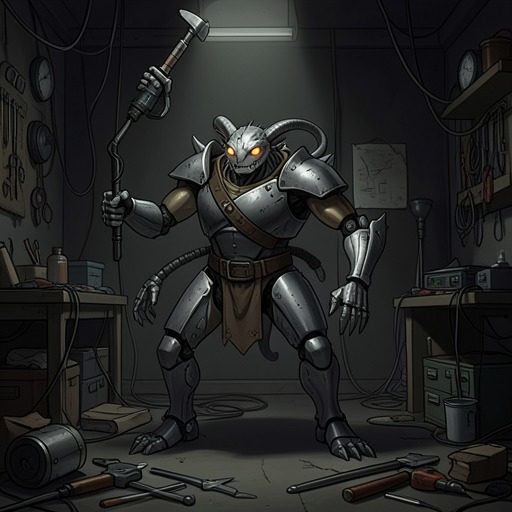
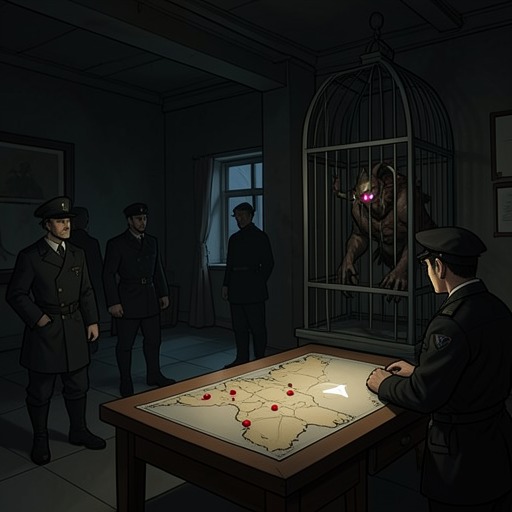
Site 214 is associated with the organization operating under No-face and functions as a controlled space for capturing and processing people judged useful or vulnerable. The facility’s exact overall layout is not described, but the available evidence presents it as a place where prisoners can be stripped, hobbled, fitted with a bell, and suspended in a meat locker while awaiting transfer. Its control is therefore both institutional and physical: the organization uses procedures, equipment, confinement, and superior levels to reduce a person to a manageable object.
The facility’s relation to other spaces also reveals the tension between enclosure and escape. William Oh’s confinement occurred in the broader context of an organization capable of tracking targets and wiping memories, yet the narrative repeatedly shows that doors, rooms, restraints, and surveillance do not guarantee obedience. Elsewhere, a featureless white room called the Class Creation Room can trap an Aspirant for two days without an exit, while a doorway later opens outside Leon’s General Store and recalls that same lethal enclosure. Site 214 belongs to this wider world of threshold spaces: places that promise controlled passage but can instead become prisons, tests, or opportunities for reversal.
William Oh as a Captured Target
During the organization’s stay at Site 214, No-face spotted William Oh as a “Target of Opportunity” and took him into custody. William Oh did not accept captivity as a fixed condition. He attempted to escape six times, and the organization responded by wiping his memory on multiple occasions. The repeated memory erasures are significant because they show that the facility’s custodians were not merely trying to overpower him; they were trying to remove the knowledge and continuity that made further resistance possible.
The procedure failed because William Oh remained dangerous even when the organization believed its advantages were overwhelming. In frustration, the captors stripped him, hobbled him, placed a bell on him, and hung him in the meat locker until delivery could be arranged. The measures are degrading as well as practical: they mark an attempt to make his body announce every movement while depriving him of mobility and equipment. Yet the resulting arrangement also creates the conditions for the captors’ mistake. By treating William Oh as immobilized property, they underestimate his capacity to manipulate the facility’s objects and prisoners.
The Seventh Escape
William Oh’s seventh escape used Experiment 327, a member of the Multi-body line. Despite the guards’ significantly higher levels, William Oh removed Boar’s key ring and passed it to Experiment 327 without anyone noticing. The act turns the facility’s security apparatus against itself: the keys that should preserve custody become the means of transferring agency from captor to captive, while the supposedly superior guards are defeated not by force but by unnoticed coordination.
The escape succeeded. William Oh and Experiment 327 evaded recapture, and Boar and Arms led Experiment 327 to a local town, where it was destroyed before it could reveal its nature to the locals. Shortly afterward, the organization received notification that No-face’s bounty had been claimed. The report therefore links Site 214 to two simultaneous outcomes: the facility loses its prisoners, and No-face becomes the subject of a successful bounty claim. Rather than restoring control, the escape sets off a chain of concealment, destruction, and organizational retreat.
Security Failure and Concealed Evidence
The report treats the escape as a mistake produced by the organization’s own handling of William Oh. Its confidence in superior levels, restraints, memory wipes, and custody procedures proves misplaced. William Oh had already demonstrated during an earlier escape attempt that he could use the functionality of a low-quality Sting Ring without possessing one physically, firing a caustic bolt from empty air into Boar’s eye. This incident should have established that ordinary searches and assumptions about visible equipment were inadequate, but the facility’s personnel still failed to account for his invisible or remotely manifested abilities.
That failure is dramatized by the Phantom Hand. William Oh’s invisible hand hovers above a group of men and waves at them while none can see it; the narration emphasizes the blunt discovery that it really is invisible. A younger Climber recognizes his dagger only after finding it embedded in the table, and an older man immediately retracts a story about William Oh being born from an unholy union between man and monster. These moments show how Site 214’s logic of surveillance breaks down when an object or ability is present but cannot be seen. The facility can restrain a body, search a person, and erase a memory, yet it cannot reliably govern what remains materially active outside the limits of ordinary perception.
Aftermath and Narrative Significance
After Experiment 327 was destroyed in a local town, the organization planned to destroy all evidence of Site 214 and wait for further orders at Fallback 14. The planned destruction confirms that the facility is not simply a place of detention but part of a clandestine operation whose existence must be concealed. Its aftermath is consequently administrative as well as dramatic: failed custody leads to evidence removal, relocation, and a return to command hierarchy rather than public acknowledgment.
Site 214 gives physical form to the book’s recurring conflict between systems and improvisation. Elsewhere, doors can imprison an Aspirant, floating mountains can sever routes by hundreds of feet of open air, and advancement can depend on following the wake of a bus while obeying the rules for clearing a Key Site. At Site 214, the same principle becomes institutional: access, movement, and information are controlled by a powerful structure, but a single key ring, an invisible ability, and an underestimated prisoner can reorganize the entire space. The facility’s decisive function is to demonstrate that confinement is never purely architectural. It depends on shared assumptions about what a prisoner can do, what an object is, and what the guards are capable of noticing—and William Oh defeats it by making each assumption unreliable.